Article
The Ecelyo methodology

The thinking behind Ecelyo (the short version)
In short: always have work ready to be completed.
Completing tasks—in other words, finishing work already under way—is at the heart of the app's philosophy and its way of working.
It does this by setting clear objectives and structuring work into repeatable steps that any AI agent can carry out, in parallel where appropriate. By design, Ecelyo does not use generic Kanban boards for tactics, though you can choose that approach at your own risk.
In short, tasks are not estimated or quantified. They are prioritised and linked to other tasks within something called a tactic. A tactic is the unit of work, and its progress is measured by how many tasks remain before its objective is complete.
When you start working with an agent, all you need to give it is the relevant skill and a command (prompt): “Finish tactic <tactic id>”. The tactic contains the information needed to complete it. Ideally, you return to the conversation a couple of hours later and find the tactic finished.
If you have automated the process, you need instructions that tell the agent which tactic to pick up (the command or routine), plus a skill describing the steps it should follow to complete its tasks. I call that a task executor.
The idea is that while you are doing the shopping or getting your hair cut, your agents can find work on their own, analyse the tactic and implement it as far as they can.
Now for the longer version
Ideally—and it does happen—tactics are completed during the day or overnight without the human needing to step in. If the next day's build has a problem, the human can return to the agent that completed the task (I save its direct link in Ecelyo so I can find the right conversation quickly) and give it a list of things to fix. Tasks can be added to the tactic and, once they have been recorded, the agent can carry on or leave them for later, depending on priorities—and, ahem, how many tokens you have left.
Rather than go over the methodology itself, let's answer a few questions that show how Ecelyo gives the user control while allowing agents to work autonomously.
First, a quick recap of the basic concepts:
Ecelyo organises work into four levels:

- System: the product or deliverable the work belongs to, with a current version.
- Project: a grouping of work within a system; for example, a product area or a specific initiative.
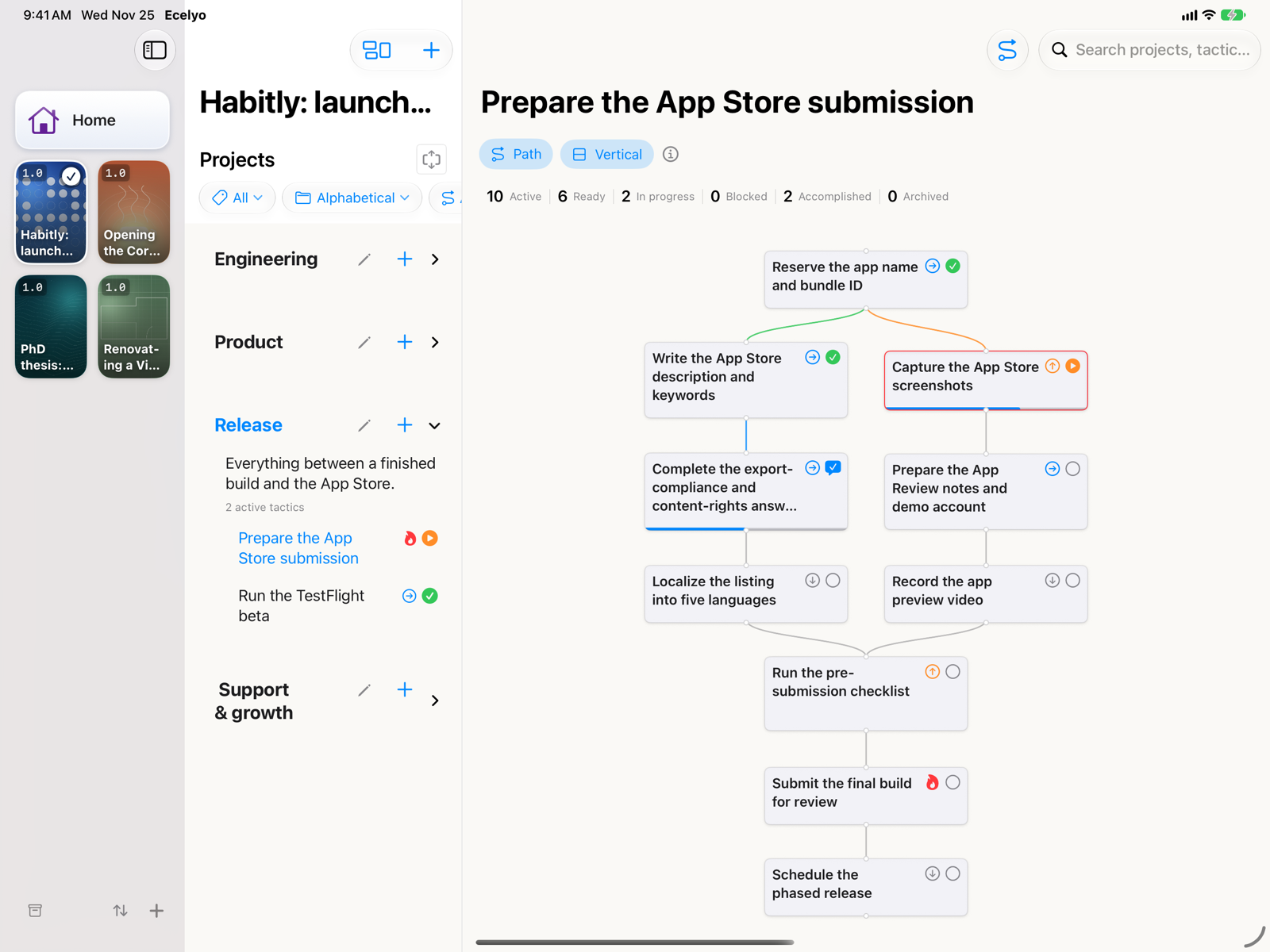
- Tactic: the main unit of work. It has a bounded objective and a release version, and groups the tasks needed to reach that objective. Progress is measured by the tasks still to complete.
- Task: a concrete piece of work within a tactic. Tasks are not estimated or quantified; they are prioritised and linked to one another so you can see what remains and organise how it gets done.
What happens if an agent gets stuck? The task is marked as “Blocked”, and its description is updated to explain why.
What if an agent has a question while working on a task? The task is marked as “In Review” to get your attention in Ecelyo (if you have not noticed another way). You answer the question and let the agent carry on.
What if I don't want an agent to work on a task without supervision? Tasks have a property called “Requires Human Review”. The agent should respect it and stop before completing the task so you can review it. I use it for user interface tasks—I always find something to refine—and for critical tasks I would rather review myself.
How do I set limits for agents? I take this seriously because too much productivity can lead to what I call “accumulated complexity”: changes left unreviewed overnight, half-finished tactics, blocked agents, unanswered questions, conflicts between tactics, or even tactics planned for a couple of releases from now that you do not want to deal with yet. Addressing this takes judgement and a little ingenuity. How do I handle it?
- Every tactic targets a version (1.2.3), and the system has a version of its own. Only tactics that match the system's current version can be started, so automations leave tactics for later releases alone.
- A limit on open tactics: you can configure how many tactics can be open when an agent asks for a task. Once the limit is reached—for example, if you do not want more than four tactics under way at once—Ecelyo's MCP stops offering tasks. The automation can then end that run without picking up another task.
The anatomy of a tactic in Ecelyo
Every tactic must have at least three tasks:
- Definition: the parent task.
- Execution.
- Review: the final task.
Think of it as a define–execute–review cycle.
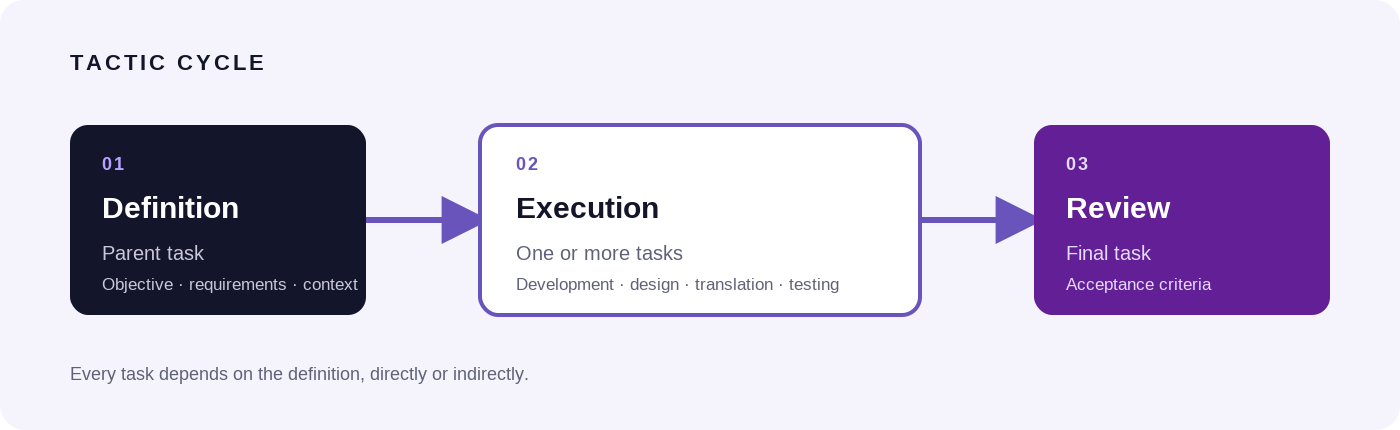
The first task is defined by the product manager: it sets out the objective and requirements, and can include conceptual designs, rules, analytics and other context. Every other task must depend on it, directly or indirectly.
Most of the remaining tasks can be assigned to a developer, though there may also be tasks for design, translation, testing or other roles. Each task should produce a concrete result or move the tactic closer to its acceptance criteria, integrating the work step by step.
Finally, every task chain ends with a review task. It checks the acceptance criteria against the initial task, any open pull requests and the reports from the other tasks. It can take a while, but it saves a great deal of time and can reduce technical debt: the agent often opens one final pull request to polish the code.
The relationship between Kaizen and Ecelyo
Kaizen is a Japanese philosophy of continuous improvement, based on making small, systematic and sustainable changes instead of pursuing large transformations all at once.
Inspired by Kaizen, I developed Ecelyo and its methodology, adding a structure that makes it easier to turn continuous improvement into concrete actions.
Kaizen is a philosophy of improvement; Ecelyo is an execution tool inspired by it.
An essential part of continuous improvement is checking whether changes produce the expected result; one common way to do this is the PDCA cycle. Ecelyo, by contrast, emphasises completing the work. Completing a tactic does not, by itself, prove that anything has improved. Ecelyo can therefore be used as a tool within a Kaizen-inspired process, but it is up to the user to add ways to assess the impact of completed tactics.
For this reason, tactics can be reopened as often as needed if their objective changes over time. A tactic started at the beginning of development can receive new tasks several releases later. This keeps the work connected to its original context and, in theory, lets each task benefit from the small decisions recorded throughout the tactic's life.
| Principle | Kaizen | Ecelyo |
|---|---|---|
| Objective | Continuous improvement | Complete objectives and make progress |
| Method | Small, incremental changes | Short, verifiable tactics |
| Organisation | Continuous improvement processes | Systems → Projects → Tactics → Tasks |
| Execution | Identify, apply and evaluate improvements | Prioritise completion over accumulation |
| Discipline | Consistency and participation | Guide the user without imposing a method |
Simple but effective
I do not think I have reinvented the wheel. The Ecelyo methodology has its name because it is used in the Ecelyo app, and it is inspired by continuous improvement.
After years of working on software projects that were often left unfinished, Ecelyo gives me peace of mind because it lets me incorporate changes bit by bit and makes the remaining work visible. When a tactic is left unfinished, that accumulated complexity must either be discarded or accepted at the expense of other priorities. Do not start what you cannot finish. If you ignore the workload, Ecelyo can stop offering new tasks so you can embrace the chaos without fear of losing control.